


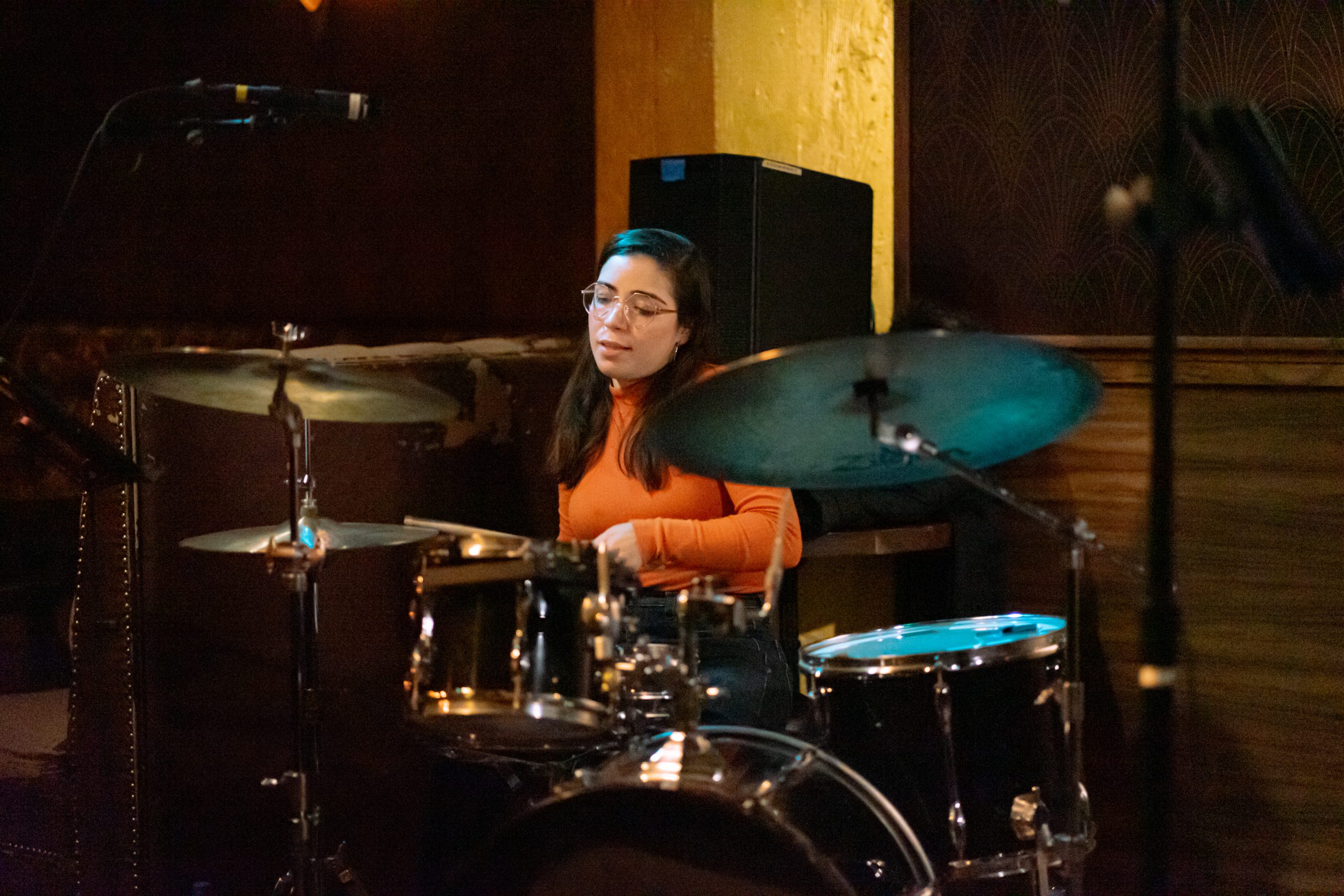
The WiMN: Let’s start at the beginning. How did music find you? What drew you to the drums as a kid, and who were some of your early inspirations?
Noa: I’m not sure exactly what drew me to drumming, but I think it was a music summer camp where I had the opportunity to drum for the first time (I was 10 years old at the time). During this time, I was still learning classical piano, and only two years after this camp, I was able to convince my parents to sign me up for drum lessons.
The WiMN: Did you always know you wanted to pursue music? Was there a defining moment in your musical journey that became clear this was meant to be your path?
Noa: I didn’t always know I wanted to pursue music, but I loved how it made me feel. I loved listening to different styles and artists and playing my instrument, but I think the pivotal moment for me was around high school. I was studying in a music program, and I just knew there was nothing else I wanted to do in life other than play drums. It suddenly became crystal clear to me, and I’ve been working in the music field ever since.
The WiMN: I’d love to learn more about your studies at Rimon School of Music for Jazz and then your transfer over to Berklee College of Music. How did each experience shape you as a drummer and an artist?
Noa: Both were amazing. At Rimon School of Music, I mostly focused on jazz studies, and when I transferred to Berklee, I expanded my knowledge and repertoire by taking ensembles and workshops and meeting people from all over the world. I learned how to play Indian music, how to record in the studio, as well as conducting and arranging.
I feel like the most I learned from, besides the teachers, was from my fellow students. I remember meeting regularly with a few drummers in an ensemble room at Berklee, setting up the drums and playing with each other for hours. We taught each other licks, and I definitely miss that time. It was incredible, and so were the people I went to school with. Some of them also moved to LA, and they are still some of my best friends.
It also definitely shaped me as a drummer and an artist. I had amazing teachers who guided me, and I took a lot from them into my professional life as a musician. One of the best drum teachers I’ve ever had was Dave DiCenso. Not only did he make me aware of my sound, time, and feel on the drums, but he is also an incredible human being, and I took a lot of inspiration from him as a person as well.
The WiMN: As a musician who wears many hats, you’re an international touring drummer who’s played among the likes of Adam Lambert, you’re a composer, arranger, and music director. What is your experience as a female drummer in a male-dominated space, and have you seen the landscape shift over the years?
Noa: There’s definitely been a shift in the landscape nowadays, as the number of great female drummers in the industry increases, whether in the touring field, recording studios, or the local scene in LA, which is incredible to see. Back when I started playing drums, there was barely any female drummer representation (or female instrumentalist representation in general). I love how all these amazing female drummers inspire the new generation, as all my role models growing up were male drummers (maybe except for the incredible Sheila E.).
Throughout the years, I’ve definitely had experiences where I was subbing at a gig or was the “newbie” on tour, and people would assume I didn’t play well because of my petite appearance and gender (I’m a 4’8” female drummer). Nevertheless, I knew that once I got on stage and played, they would change their minds, and it was fun to see the shift in their attitude toward me when they realized I could actually play well.
The WiMN: Do you have any advice for other female-identifying drummers who also aspire to be a composer or an arranger?
Noa: Yes, definitely. I would say that you can achieve anything, literally. If you write something and are overly judgmental about it, just release it. This applies to both compositions and arrangements. The next time you write a piece, it will be better than the previous one, and so on. If you keep perfecting one piece, you’ll never learn from your mistakes, as you’ll keep procrastinating the delivery.
So my advice is to release your compositions and arrangements and to keep writing more and more music, as this is the only way to get better. At least that’s how I feel about my music and arrangements. It’s never going to be perfect, but that’s great because music reflects life, which isn’t perfect either. That’s where all the beauty is.
The WiMN: I’d love to dive into your writing process. I listened to both ‘Winter Peaks’ and ‘Coming Back Home.’ Can you walk me through your writing process? I loved the jazz fusion sensibility, and because you’re a drummer, my ear immediately went to listening to the drums in these songs. As a drummer and in your writing process, do you look for ways to allow the drums/rhythm section to lead?
Noa: Thank you. When I write my own music, I don’t usually write from the drummer’s perspective. I start with melodies and harmonies on the piano and then figure out the groove. The drums in my tunes usually accompany the instrument that plays the main melody. However, I did recently release a tune (drum and bass) where the drum groove was the main component, but that is unusual for me. Melody is usually the key for me when writing music.
The WiMN: As an artist, what do you hope listeners walk away with their feeling and understanding of you as an artist?
Noa: My goal is to make the audience feel something. Obviously, it changes from one piece to another, but I want to be able to affect someone. Maybe they miss something from their childhood while listening to my tunes. Maybe they feel regret or grief, or maybe they feel joyful. Everyone’s interpretation is different. But making someone feel something is what I love when listening to music. That’s why we always go back to our favorite songs, as they make us feel a certain way. And we listen to different music depending on our current mood, at least that’s how it is for me.
Because everyone has a different interpretation, one person could have a different understanding and feeling for a tune than another. And that’s great, as we are all different and experience different things in our lives. I don’t want my audience to feel exactly the same thing or interpret my music in the exact same way.
The WiMN: What other projects do you have coming down the pipeline that you can share with us? How can people follow what you’re up to and any shows you might have upcoming?
At the moment, I’m working on some new music for a new EP. I’m also looking forward to arranging more live shows for artists. I usually post about my projects on my Instagram or on my website, so my audience can learn more about my future projects there:
Instagram: @noakahn
Website: noakahn.com


