


By Guest Contributor, Lyndsey Parker
When Sarah McLachlan founded the all-women Lilith Fair festival in 1997, many industry detractors dismissively and derisively claimed that a “pussy package” — that is, a concert featuring multiple female artists, which seemed like a novelty at the time — would never sell tickets. McLachlan of course proved those doubters wrong, when Lilith Fair made herstory as the most successful financial touring festival of all time. But after the pop-cultural pendulum swung back towards to shiny TRL pop and hypermasculine nu-metal in late ‘90s/early 2000s, Lilith’ legacy was sadly lost — so much so that in this year’s Lilith Fair documentary Building a Mystery, an incredulous Olivia Rodrigo confessed that she never even knew about festival until recently.
But almost 30 years later, on what a giddy Rodrigo called “the best day of my f***ing life,” Aug. 29, the pop star stood onstage at Irvine, Calif.’s Great Park at her own all-female festival, Daisy Chain Fields, in front of 45,000 delighted fans — many of them men who didn’t at all seem like they’d been dragged there by their wives, girlfriends, or daughters (although, sweetly, there were quite a few supportive girl dads in the crowd). And in one of the 10-hour day’s many touching moments, special guest McLachlan was right by Rodrigo’s side.
“I’m so aware of all the women that came before me, all the women that fought so I could speak my mind,” declared Rodrigo, who noted that her mother and grandmother were in the audience. “At a time when people said that two women couldn’t be headliners on the same festival bill and two women couldn’t be played back-to-back on the same radio station, [McLachlan] created the first all-women festival and shattered everyone’s expectations. Without Lilith Fair, there would be no Daisy Chain.”

“I’m proud and honored to be part of this inaugural festival that Olivia has created. This is a beautiful full-circle moment for me. I’m so freakin’ happy to be here,” a beaming McLachlan declared, before she and Rodrigo joined forces for “Building a Mystery” and then dedicated “Angel” to the late, great Dolly Parton, who McLachlan noted was the “most philanthropic artist in the history of country music.” In true Dolly spirit, all 14 Daisy Chain Fields artists performed for free, helping the festival raise $10 million for various charities including Baby2Baby, Black Mamas Matter Alliance, Center for Reproductive Rights, FreeFrom, the National Institute for Reproductive Health, the National Women’s Law Center, and Planned Parenthood; humanitarian Melinda French Gates then pledged to double that amount, thus bringing the grand total to a staggering $20 million.
Those 14 acts on Rodrigo’s impeccably curated, cross-genre, cross-generational Daisy Chain Fields lineup ran the gamut from new-school indie (moshpit-inciting Texas punks Die Spitz, art-pop singer-songwriter Mitski) and rainbow-bright pop (Fifth Element-uniformed femininomenon Chappell Roan, rap funktress Doechii) for the kids, to Gen X/millennial trailblazers for all the chaperoning hipster moms and above-mentioned girl dads, like Bikini Kill, the Breeders, Garbage, Santigold, and surprise guest Alanis Morissette, who Rodrigo said “helped shape me into the woman I am today.”
However, it was heart-gladdening to see 12-year-olds grooving to the Breeders’ bass-rumbling college-rock classic “Cannonball” and shouting themselves hoarse to Bikini Kill’s riot grrrl clarion call “Rebel Girl,” or to witness forty- and fiftysomethings earnestly arm-spelling the audience-participation cheerleader chants of Roan’s “Hot to Go!” and holding their illuminated iPhones aloft for a mass singalong of Rodrigo’s heart-on-babydoll-sleeve emo ballad “Drivers License.” (Rodrigo is perhaps the most generation-bridging pop force of her generation, thanks to her recent collaborations with Robert Smith, David Byrne, Smashing Pumpkins, No Doubt, and Billy Joel, as well as her own music’s clear pop-punk and post-punk influences.)
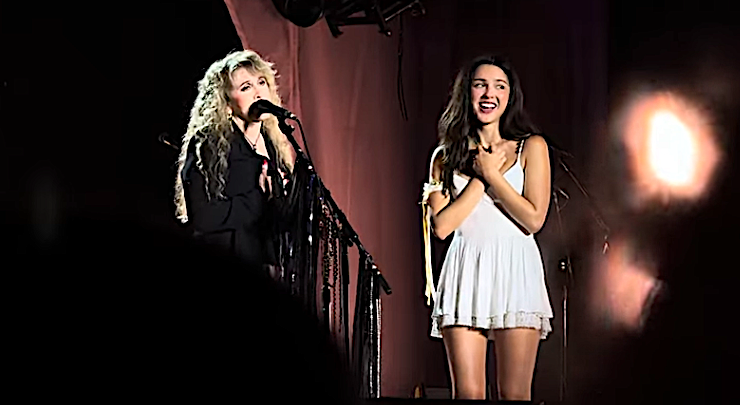
And then there was the most special of special guests, the eldest and most stately of Daisy Chain’s elder stateswomen: the universally adored Stevie Nicks. At the end of the evening, the legendary witchy-woman girlishly skipped hand-in-hand with Rodrigo onto the main Dandelion Stage and proclaimed that she was “awestruck” by Rodrigo’s “grace” and “crazy, crazy energy,” but it was Nicks herself who truly left the audience (and a starry-eyed Rodrigo) in awe, and maybe even in tears.
As Waddy Wachtel, one of the few men to appear on either of Daisy Chain’s two stages, strummed solemnly, the 78-year-old Nicks crooned, “Time makes you bolder/Even children get older/And I’m getting older, too” — world-weary lyrics that she penned at the way-too-tender-age of 27 (not much older than Rodrigo is now) that feel so much heavier and hit so much harder all these decades later. And when Nicks reverently mouthed along to the verses sung by the wise-beyond-her-years with Rodrigo, or spun in gypsy dance circles with her winsome duet partner, it felt like a torch-passing moment. Nicks even lingered after their emotional festival-closing number to tell the audience, “[Rodrigo] reminds me a lot of me when I was her age, a hundred years ago! … She’s very special. Take her to your heart. I have.”
All of the festival’s older artists expressed gratitude to Rodrigo for the opportunity to play her historic festival and spread her message of hope, like when Breeders bassist Josephine Wiggs told the Marigold stage crowd, “Against the dystopian tide, believe that human well-being is a human right, not a privilege. Thank you, Olivia, for inviting us to be a link in the Daisy Chain, and for reminding us that we rise or fall together.” But no one was more appreciative or outspoken that Garbage’s always fierce and fearsome frontwoman, Shirley Manson, who’d celebrated a milestone birthday just a few days earlier.
“This is kind of wild. To see so many of you out there tonight is amazing,” Manson gushed, taking advantage of some concert-stalling technical difficulties to banter freely. “Thank you for coming over to this stage and catch this OG band. We’ve been around a long, long time. We’ve been around since before most of you were born, so to be included in this festival lineup is an immense privilege, and it’s not one we take lightly. There’s so much talent out there, and we are thrilled to be sharing the stage with some of the greats out there today. Chappell Roan, and Olivia obviously, who’s just put all this together, which has been astounding and galvanizing an entire generation of women to stand up for ourselves, to believe in ourselves, to not accept the status quo, to believe that we can push things forward again. We’ve taken a few steps back lately, and we are not going to tolerate that. I think we all know that. So, a night like tonight is very, very important for all of us women, myself included, to be part of this Daisy Chain that will stick with you for the rest of your life, to understand that there is community and there is power in the galvanization of women all over the world. … And I just want to assure you all, because I just turned 60, so I’m very old! I know exactly Olivia and Chappell’s reach, Doechii’s reach, Mitski’s reach — they’re all powerful women who are reaching large audiences, not just here in the United States of America but around the world. … We have power. Let’s f***ing use it!”
Garbage fittingly launched their set with the misleadingly titled “There’s No Future in Optimism” and its booming “if you’re ready for love” rallying cry, then mashed up “Stupid Girl” with Bikini Kill’s “Rebel Girl” and encouraged the crowd to “let their freak flag fly” to their queer cult anthem, “Cherry Lips (Go Baby Go!).” But Manson really let it rip for 2025’s “Chinese Fire Horse,” an unhinged, expletive-riddled rebuke to ageist, misogynistic haters that fired up audience members of all ages. By the time she belted “When I Grow Up,” probably every Gen Z girl at the Marigold Stage had decided they wanted to be Manson when they grew up.
Kathleen Hanna, the iconic frontwoman for Bikini Kill — the pioneering feminist punk group that that Manson declared “f***ing began all this s***,” and that FreeFrom founder Sonya Passi said “taught an entire generation that you don’t wait for permission to be loud about what matters” — was also in fine fiery form and bantering up a storm. Before she even roared a single ferocious note of Bikini Kill’s opening song, “This Is Not a Test,” she bluntly told the Marigold crowd: “For a lot of us, we feel obviously like this government f***ing hates us and wants us dead, and they don’t give a s*** about anybody’s healthcare. They don’t care if we’re dying in parking lots of curable illnesses. They don’t give a s***. They don’t care if our rights are taken away. They’re ripping people off the streets. I’m not going to tell you all the bad things, but I am going to say it makes it hard for me and my body sometimes to have a good time, because it’s hard to be able to play for you. So, what a gift Olivia has given all of us to do this festival. I just want to have fun like it’s a basement party, y’all!”
Hanna then defiantly screamed, “We’re Bikini Kill and we want revolution! Girls, girls, girls!” and later joked that she didn’t even have to shout her band’s usual slogan, “Girls to the front,” because the Great Park field was already filled with female fans. Even when Hanna shared the sad real-life story behind “Feels Blind” (about a 40-year-old male family friend making a pass at her when she was just 17), she marveled at the audience’s attentiveness as fans hung on her every word and plot-twist, laughing, “I swear, this the most engaged crowd I’ve ever seen!” Explaining that that song had been pulled from the pages of her teenage journal, she encouraged the young spectators to hold onto their own diaries, saying, “Don’t throw your journals away — that’s your f***ing art!” And then, in one of the day’s other torch-passing moments, she invited Irvine punk band Emily’s Sassy Lime, whose members were among the few women who attended Bikini Kill’s early Orange County gig in the early ‘90s, onstage for an exhilarating “Rebel Girl” finale that really did feel like a basement party.
Daisy Chain Fields was fairly well-organized for a new festival — because there was a woman in change, many joked — with no overlapping set times and five-to-10-minute walk between the two stages, thus making it possible to zip from Mitski to the Breeders to Doechii to Garbage to Chappell Roan to the Marias singer Maria Zardoyya’s dream-pop side-project Not for Radio, all before catching Rodrigo’s big headlining set. But hour-long concession queues and, according to some disgruntled Redditors, hours-long queues for the gridlocked parking shuttles tested festivalgoers’ endurance and patience.
And “mother” Olivia was no match for Mother Nature, so the Coachella-level extreme heat, lack of shaded areas, and inexplicable parasol ban, coupled with an early start time (the day’s first artist, folktronica singer-songwriter Quiet Light, went on at 11:30 A.M.) made that five-to-10-minute walk feel like a trek through the Sahara. When Roan sang about being “hot to go” and feeling “like 199 degrees,” or Manson sang about being happy when it rains, the weather jokes practically wrote themselves. “Oh my God, Irvine, you’re so hot,” panted Doechii — a Floridian who should have been used to sweltering climates — as she ran the risk of her panther-pink body paint melting before her sweaty set was over. “Is it always like this here?” (No, it’s not, Doechii… but it is in August.)
At one point during Mitski’s set, she suggested that Daisy Chain Fields should take place every year, after which she quipped, “No pressure, Olivia!” But when Rodrigo bid farewell at the end of the night, she did excitedly shout, “See you next year!” — which means she does intend to follow the Lilith Fair tradition and make her festival an annual event. There are so many artists who’d brilliantly carry on this tradition, including Katseye and Karen O, who will hopefully be invited back after having to cancel this year’s appearances at the last minute. So, for Daisy Chain Fields 2027, we nominate, in alphabetical order: Lily Allen, Amyl & the Sniffers, Fiona Apple, Arca, Alice Bag, a reunited Boygenius (or any of their individual band members), Bjork, Bratmobile, Sabrina Carpenter, Cat Power, Charli XCX, Miley Cyrus, Olivia Dean, Doja Cat, Billie Eilish, the reunited Elastica, Missy Elliott, FKA Twigs, the Go-Go’s, Heart, the reunited Hole (or just Courtney Love), Grace Jones, Lady Gaga, Carly Rae Jepsen, Joan Jett, Kelsy Carter, Kesha, Ladytron, Lambrini Girls, the Last Dinner Party, Zara Larsson, Cyndi Lauper, Avril Lavigne, the Linda Lindas, Melanie Martinez, Kylie Minogue, Mz. Neon, Arlo Parks, Suzi Quatro, Raye, Robyn, Rosalía, Patti Smith, Starcrawler, SZA, Shania Twain, the Warning, Suki Waterhouse, Hayley Williams, and Lola Young. That’s enough for more than two stages, and more than just one day — just as long as those days aren’t in August.
The Women’s International Music Network is a 501(c)(3) non-profit. Support our programs by donating here.


